Amber & Jewelry
Succinite: what Baltic amber actually is
Call it succinite and you have said something precise: a fossil resin of Eocene forests, loaded with the succinic acid that imitations cannot reproduce.
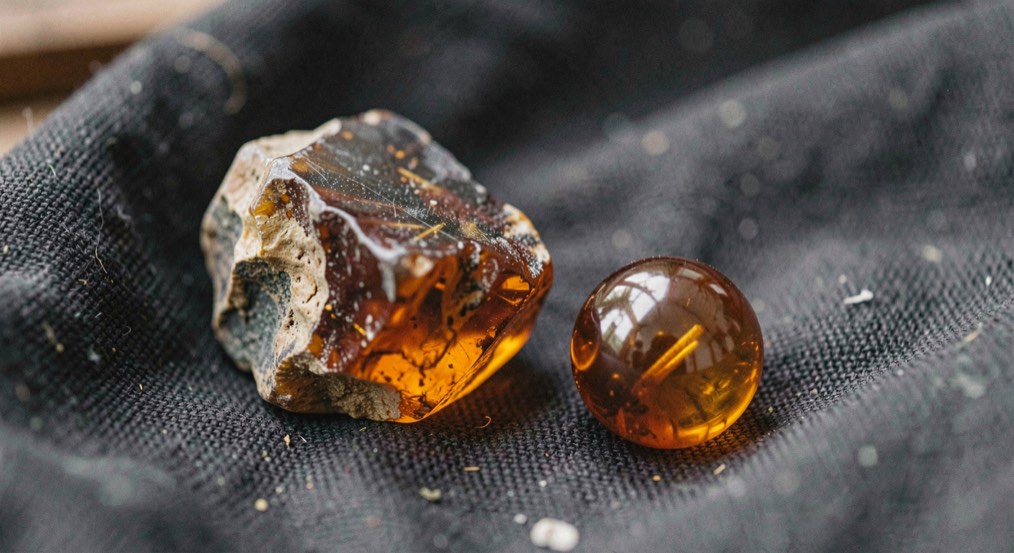
Amber is not a stone and it is not sap in the syrup sense: it is the fossil resin of forests that stood along the Baltic tens of millions of years ago, buried, chemically transformed and then pushed and washed back into human reach. The Baltic variety has a name of its own, succinite, taken from its signature chemistry, and that name is the honest starting point for every question about authenticity that follows.
A forest that became a trade
The source forests of Baltic amber are usually described as coniferous woods of the Eocene, with a resin producing tree often referred to in the older literature as Pinus succinifera, the amber carrying pine. The resin bled, flowed, sealed insects and plant fragments where it caught them, hardened and was carried by rivers into a delta that today lies under the southeastern Baltic coast. Dates cited for the deposit cluster around forty four million years, with some material older and some younger.
People found it before they could explain it. Amber traveled south long before Rome, and the trade routes that carried it are known to history as the Amber Road; Roman writers discussed its origin and Pliny the Elder argued, correctly in principle, that it was tree resin rather than a mineral of the earth. For long stretches of its history the material was literally worth more than salt or metal by weight, and laws in Prussia reserved rights over it for centuries.
What succinite means
The chemistry gives Baltic amber its identity. Succinite contains succinic acid, typically on the order of three to eight percent, and no other amber in the world carries this signature in the same way; the name of the acid and the name of the amber share a root, from the Latin for the fruit of the mountain ash, succinum, a poetic guess at the resin’s source. Succinic acid content is the kind of fact a laboratory can test and a piece of plastic cannot fake, which is why serious certificates mention it.
The rest of the profile is physical. Amber is soft, around two to two and a half on the Mohs scale, so it takes a warm polish but scratches with ease; it burns and smells of resin when it does; and it carries a static charge when rubbed, a property noted since antiquity, whose Greek word for amber, elektron, gave electricity its name. Baltic material is also famous for what it sealed inside itself: insects, spiders, feathers and flowers preserved in mid gesture.
Where the world’s amber sits
The most concentrated deposits known lie in the Sambia peninsula of the southeastern Baltic, around the settlement of Yantarny, whose open pit workings have supplied most of the world market for generations. Estimates commonly attribute on the order of ninety percent of the world’s extractable amber to this Baltic resource, which is why Baltic amber is the reference material and why imitations so often dress themselves in its name.
| Property | Figure | Why it matters |
|---|---|---|
| Age of the deposit | around 44 million years | No modern resin, such as copal, can claim the date |
| Source material | Fossil resin of Eocene conifer forests | Explains the resin smell and burning behavior |
| Succinic acid | about 3 to 8 percent | The signature that names succinite and fails in plastic |
| Density | about 1.05 to 1.10 | Barely heavier than fresh water, floats in strong brine |
| Hardness | about 2 to 2.5 Mohs | Warm polish, easy scratching, careful storage |
| Main deposits | Sambia peninsula, Yantarny | Baltic material dominates the world supply |
Why the geology is a buying tool
Every property in the table returns as a test in the shop or at home. The resin origin explains the pine smell a hot needle releases and plastics never do; the density explains the famous salt water float; the softness explains why genuine old beads carry wear and why a perfect surface on a cheap piece should raise a question. Knowledge of the material is not background reading: it is the recognition kit.
The inclusions work the same way. A trapped insect is not automatically proof of authenticity, since pressed and reconstructed material can carry inserted objects, but a well preserved insect in the right posture, with the fine detail Baltic amber is famous for, is the kind of evidence a museum buys and a factory cannot pour.
A collector’s checklist
- Ask for the word succinite, and treat vague answers about amber origin as information.
- Handle for density and softness: heavy plastic and glass both feel wrong against the finger.
- Look for crust on raw pieces, since genuine sea or pit amber carries a weathered skin.
- Treat certificates seriously when they name succinic acid, and read what they actually certify.
Common mistakes
- Calling every yellow transparent bead amber, when copal and resin plastics share the color and nothing else.
- Trusting a single dramatic inclusion, which reconstructed pieces can fake, over the whole physical profile.
- Cleaning amber like agate, forgetting that a two on the Mohs scale scratches at home.
- Paying prehistoric prices for a story, when the geological facts are the part that can actually be checked.
The bottom line: know the material before the market. Succinite has an age, a chemistry and a geography, all of them checkable, and a buyer who keeps those three facts in hand is already ahead of most of the trade.