Painted Crafts
Painted trays and lacquer boxes: Zhostovo and the miniature villages
Two painted traditions on humble grounds: flowers on iron trays from one village near Moscow, and fairy tales in tempera on papier mache from four.
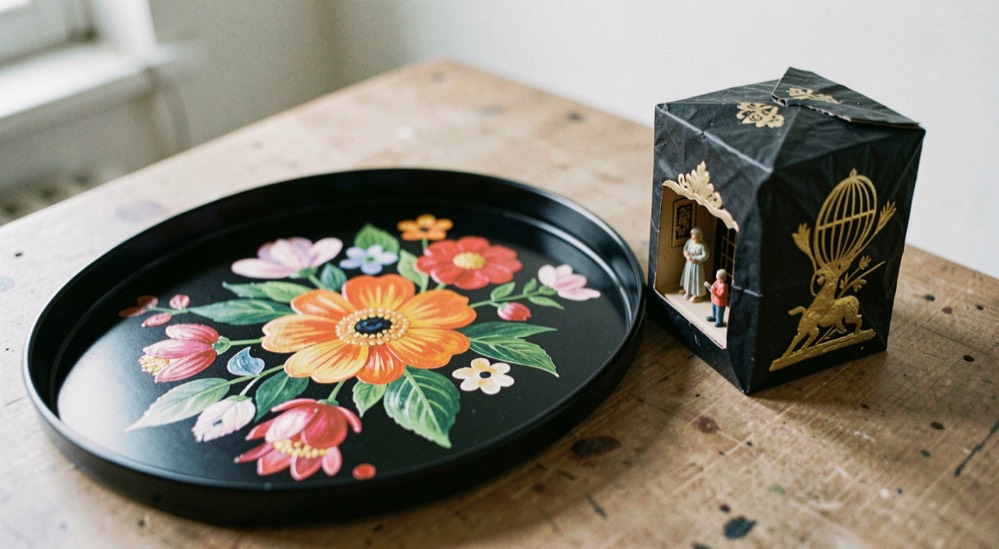
Not every Russian painted craft is old. The painted metal tray of Zhostovo is a product of the 1820s, an industrial age flower on an industrial age object, and the lacquer miniature boxes that collectors prize were largely born in the early Soviet years, painted by former icon painters applying their training to fairy tales. Both traditions are young enough to be documented and distinct enough to be learned, which makes them among the most collectible painted wares of the region.
Zhostovo: bouquets on iron
In the 1820s, in the village of Zhostovo near Moscow, workshops began painting metal trays by hand: black lacquered grounds, oil painted bouquets, edges finished with a fine border line. The trade grew from several family workshops and consolidated into the one identity the market knows, a round or rectangular tray that carries a bunch of garden flowers with a heavy, confident realism. The bouquet is painted freehand, often in layers, with highlights and shadows built up wet in wet, and no two trays repeat exactly.
Recognition is pleasant work. The ground is genuinely metal, cold and rigid under the paint; the brushwork is wet in wet oil, with colors melting into one another at petal edges; and the border, a thin light line near the rim, is applied by hand and wobbles honestly. Imitations printed with a photographic bouquet show the dot lattice under a loupe and a suspiciously perfect border, and light tin sheet with a sprayed ground feels like the stamping it is.
Shapes and grounds carry their own vocabulary. Round trays dominate, with octagonal, rectangular and oval companions, in sizes from a small stand to a table wide enough for a samovar service. The classic ground is black, but the workshops have always painted on deep red, green and blue grounds for particular lines, and gilt edging appears on show pieces. Collectors treat the ground color as part of the date conversation: catalogues of the trade record when each range was introduced, and the museum attached to the trade keeps the reference trays.
The lacquer miniature villages
Papier mache boxes lacquered black and painted inside a world of their own come from four villages, each with a documented origin and a recognizable manner. Fedoskino, near Moscow, is the oldest school, growing from a late eighteenth century factory and painting in oils with a realistic, often genre bent style. Palekh, Mstera and Kholuy, old icon painting towns of the Vladimir region, turned to miniatures in the early Soviet years when icon commissions stopped: Palekh in 1923, Mstera the same era, Kholuy following in the 1930s, all painting in tempera with gold accents on black ground.
The schools diverge in ways catalogues love and buyers can learn. Palekh favors dense, many figured compositions from folk tales and epics, in bright reds and golds on deep black. Mstera paints on a paler, warmer ground with finer, more architectural detail. Kholuy tends to darker, reddish orange palettes and generous silhouettes. Fedoskino, alone of the four, works in oils and often frames a realistic scene like a window.
| School | Medium | Ground and palette | Typical subject |
|---|---|---|---|
| Fedoskino | Oil painting | Black lacquer, realistic tones | Genre scenes, landscapes, portraits |
| Palekh | Tempera with gold | Black ground, bright reds and golds | Folk tales, epics, many figured scenes |
| Mstera | Tempera | Paler warm ground, fine detail | Architecture, tales, delicate pattern |
| Kholuy | Tempera | Darker, reddish orange palette | Bold silhouettes, tale subjects |
| Zhostovo | Oil on painted metal | Black lacquered tray, garden palette | Freehand floral bouquets |
What quality looks like on a small box
A serious miniature is painted by a named artist, and the base tells you: signature, village and often a title on the underside, in ink or gold. The lacquer should be smooth to the fingertips, the sides deep black and even, the hinge quiet. Inside, the paint does the talking: figures with definition, a composition that reads at arm’s length, and gold applied with a pen like confidence rather than dusted everywhere. Factory production lines of the same villages make simpler boxes at honest prices, and the base marks are the honest difference.
Zhostovo trays follow the same rule of names. Workshops sign, and a signed tray prices above an anonymous one of similar beauty; the freehand bouquet means the market rightly treats each tray as a single work.
A collector’s checklist
- Turn the box over first: signature, village and title are the credential.
- Match the manner to the school using the table, before matching it to the price.
- Feel the lacquer and the hinge; smoothness is process, not luck.
- On trays, loupe the bouquet for print dots and check the border line for an honest wobble.
Common mistakes
- Calling every black lacquer box Palekh, when four schools share the ground and not the manner.
- Paying miniature prices for a printed tray bouquet, one loupe away from exposure.
- Trusting a generic stamp without a painter’s name on a box offered as author work.
- Storing trays stacked without padding, scratching the very paint that carries the value.
The bottom line: these are the youngest painted crafts on this site, and their youth is an advantage. Origins are documented, schools are distinct, artists sign their work; a buyer who reads the base and the brush knows exactly what is being purchased.