Textiles & Shawls
Down and lace: the steppe shawl and the northern braid
Two handmade textiles from the opposite ends of the country: gossamer down knitted in the steppe, and a lace braid winding through the northern snow.
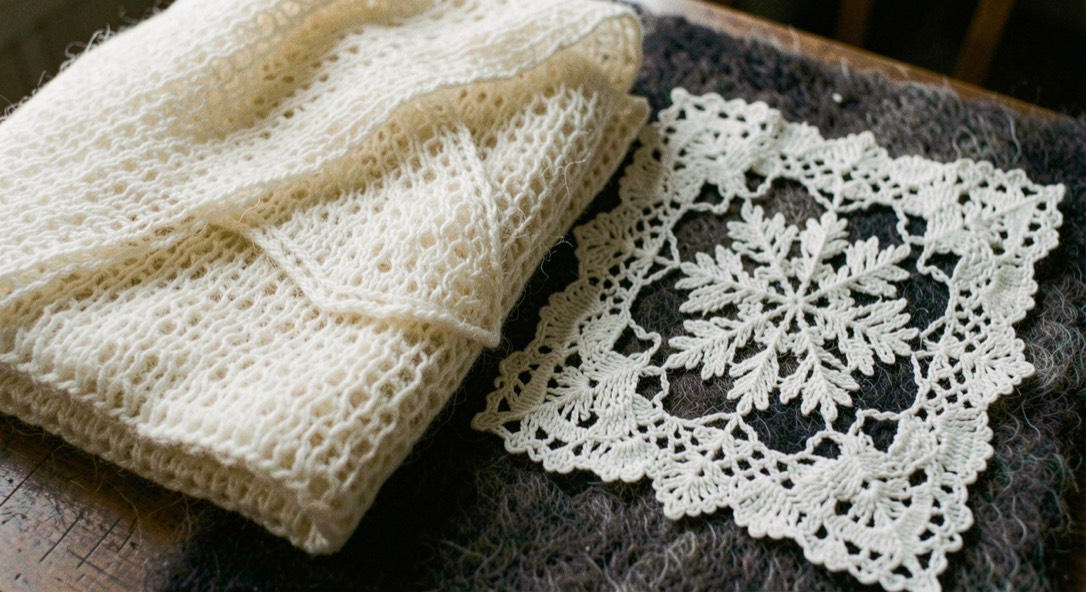
Two textile crafts, two climates. On the Orenburg steppe, knitters have worked the down of local goats into shawls so fine a full sized square weighs about as much as a bar of soap and, by fairground legend, passes through a wedding ring. In the northern town of Vologda, lacemakers twist bobbins into a dense white braid that winds around snowflake and rooster motifs. Both are documented, both are imitated, and both announce themselves to a careful hand within a minute.
Orenburg down: the feather that warms
The craft is tied to the coarse haired goats of the Orenburg region, whose down is among the finest recorded for the purpose, commonly cited around sixteen to eighteen microns, thinner than most sheep wool by half. Knitters of the region have worked it since at least the eighteenth century, and the trade grew famous enough that down shawls became an export curiosity by the nineteenth. Three forms dominate: the warm dense shawl for daily wear, the gossamer pautinka, literally spiderweb, and the wider patterned stole.
The numbers are the romance. A gossamer shawl of about a meter square can weigh near a hundred grams, knitted from hand spun down so fine the cloth breathes smoke when shaken; and yet, knitted in the traditional openwork, it insulates honestly. The fibers carry tiny scales that grip without prickle, which is why genuine down feels warm at once against the wrist while synthetic puff feels like nothing until bunched.
Reading a down shawl honestly
Recognition starts with construction: genuine pautinka is knitted, and the loops are visible, even and continuous into the pattern; the openwork grid is symmetric; and the edge is crocheted or knitted, never serged. Weight is the second check: a fine full square that weighs like a sweater is not gossamer, whatever the label. Third, the fiber: real down has a faint natural scent, warms on contact, and a strand pulled gently from a hidden seam, a small sacrifice for a big question, burns like hair with a specific smell, while acrylic melts to a hard bead. Color stays natural: gray, cream and white from the goats themselves, since honest down is rarely bleached.
Vologda lace: the braid that draws
Vologda lace grew in the nineteenth century from household and estate workshops into a named regional industry, worked in bobbin technique: dozens of wooden bobbins twist pairs of threads around pins set in a pattern drawn on a roller. The Vologda manner is distinctive and learnable: a dense, continuous woven braid, the plitka, outlines the motif, and the ground between is open mesh. Snowflakes, fans, roosters and flower medallions are the classic figures, worked in unbleached linen or cotton thread that reads white against any cloth.
Machine net imitations fail on the braid: a real plitka has the slightly irregular rhythm of hand tension, and the mesh joins it cleanly; stamped machine lace shows a uniform grid and a motif pasted on rather than grown out of the ground. Genuine pieces are worked in one continuous piece, so the pattern and the mesh cannot be separated without a seam.
| Feature | Orenburg down shawl | Vologda lace |
|---|---|---|
| Material | Goat down around 16 to 18 microns | Unbleached linen or cotton thread |
| Technique | Hand knitting, openwork grids | Bobbin lace, dense plitka braid and mesh |
| Motifs | Snowflake grids, openwork corners | Snowflakes, roosters, fans, medallions |
| Signature weight | Gossamer square near 100 grams | Weight in the braid, mesh open |
| Failure of fakes | Acrylic weight and melting bead | Uniform grid, motif not grown from ground |
| Indicative price | Modest for warm shawls, multiples for gossamer | By size and density of the braid work |
Buying the maker, not the story
Both crafts carry cooperative and workshop signatures, and both markets see tourist grades. The down trade labels pieces by maker and weight class; serious sellers state the district and the form, warm shawl, pautinka or stole. Lace is signed by the artel or factory of origin on labeled cards, and older museum documented patterns recur with proper credits. A buyer who asks for maker, form and fiber in the same breath is usually answered honestly, because the question is too specific to bluff.
A collector’s checklist
- Weigh a down shawl in the hand; gossamer is impossibly light, and that impossibility is the point.
- Follow one knitted loop with a finger; evenness and continuity are the hand’s signature.
- Trace the lace braid; it must wind through the whole piece without a seam.
- Ask for maker and fiber in one question, and price the specific answer.
Common mistakes
- Buying a puffy acrylic wrap as gossamer, defeated by the scale or the burn test.
- Washing down shawls like cotton, when cool water and flat drying keep the loft.
- Calling any white machine net Vologda lace, an insult the braid refutes on sight.
- Paying for bleached whiteness, when honest down keeps the goat’s own gray and cream.
The bottom line: these two textiles reward the hand more than the eye. Weight, loop, braid and fiber settle in a minute what labels argue about for pages, and once held, a genuine pautinka or a true plitka is never forgotten.